

In Spanish there are two verbs translated into English as “to be”. The first, “ser”, has a sense of permanence so you might say something like “I am (ser) a daughter of God” meaning I am and will continue be a daughter of God. The second, “estar”, is fleeting. You might say, “I am (estar) here”, but I won’t always be here.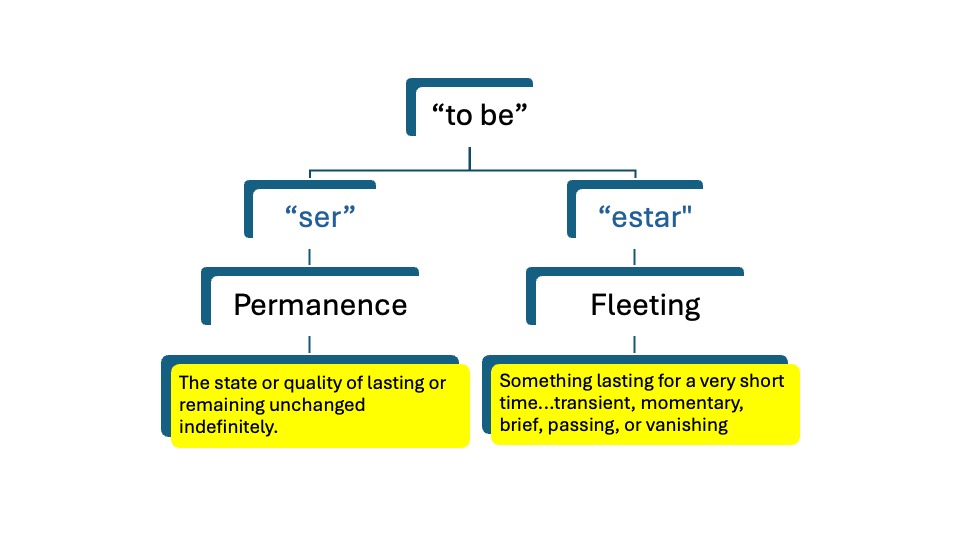 In Exodus, God called Moses to bring the Israelites out of Egypt. Moses asked God, “who will I say sent me”? God told him to say to Israelites that “I AM” sent you.
Exodus 3:13-14: Moses said to God, “Suppose I go to the Israelites and say to them, ‘The God of your fathers has sent me to you’, and they ask me, ‘What is His name?’ Then what shall I tell them?”
God said to Moses, “I am who I am”. This is what you are to say to the Israelites: “I am has sent me to you”.
The verb tense used by God to describe Himself has permanence similar to the Spanish verb “ser”. The Hebrew tense connotes that God is the same for all time.
The permanence of God
The permanence of God refers to His eternal and unchanging nature, which is expressed through:
- The endurance of His word...to you
...Isaiah 40:7: The grass withers and flowers fade away, when the Lord’s breath blows on them, but the Word of our God will stand forever.
- The endurance of His promises...to you
...Joshua 21:45: Not one of all the good promises the Lord gave to the house of Israel had failed...every promise was fulfilled.
- The endurance of His presence...with you
...Matthew 28:20: Teaching them to observe all that I have commanded you. And behold, I am with you always, to the end of the age.
This doctrine is central to Christianity and to the life of every born-again believer. It assures believers that God's love, justice, and character will always remain constant despite the transient nature of the world. This guarantees a foundation for our hope and peace.
Elements of God's permanence
- Eternality and immutability: God has no beginning or end, and His attributes, such as His perfection, are eternal and unchanging. This means He exists outside of time and is not subject to change or alteration.
- Unchanging word and promises: Scripture emphasizes the lasting nature of God's Word and promises. Remember the verse that states that "the word of our God stands forever" and that His covenants are everlasting (reliable and true).
- Enduring presence: God's presence is considered to be constant and everlasting, providing comfort and strength to believers through all circumstances. The New Testament affirms God dwelling with His people eternally.
- Eternal love and justice: The permanence of God is also seen in His unwavering love and His commitment to justice. This gives us hope and confidence, that despite temporary injustices, God’s righteousness will ultimately prevail.
Before Moses lived, the Biblical narrative had multiple times where God was present and acted on the behalf of His people. The first time was when God created and interacted with Adam and Eve. God put them in the garden and gave them the responsibility of taking care of the garden.
Adam & Eve
Genesis 1:28: God blessed them and said to them, “Be fruitful and increase in number and fill the earth and subdue it. Rule over the fish in the sea and the birds in the sky and over every living creature that moves on the ground”. (NIV)
When they sinned and were kicked out of the Garden of Eden, their understanding of God was obscured. God did this out of mercy since fallen man would die if confronted with God’s glory.
I Corinthians 13:12 describes this as follows, “For now we see only a reflection as in a mirror. Then we shall see face to face. Now I know in part, but then I shall know fully, even as I am fully known”.
Noah
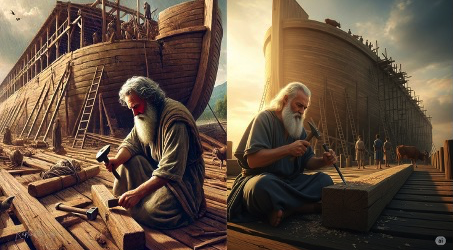
Noah is another person who God used in His work. Because Noah was a faithful and righteous man, God used him to carry on the human race when God destroyed all who were not on the ark. God gave Noah the dimensions and instructions for building the ark.
Genesis 6:14-16: So make yourself an ark of cypress wood. Make rooms in it and coat it with pitch inside and out. Here is how you are to build it. The ark is to be three hundred cubits long, fifty cubits wide, and thirty cubits high. Make a roof for it, leaving below the roof an opening one cubit high all around. Put a door in the side of the ark and make lower, middle and upper decks”.
https://www.pinterest.com/pin/8655424281504408/
God promised Noah He would establish His covenant through him in Genesis 6:18: But I will establish my covenant with you, and you will enter the ark—you and your sons and your wife and your sons’ wives with you.
The animals came to Noah and entered the ark. (I believe that God directed the animals to go to the ark, so they would be able to replenish the animal population after the flood.) When the animals were in the ark, God Himself shut the door.
In Genesis 7:15-16,God commanded all creatures that have the breath of life in them to come to Noah and enter the ark. The animals going in were male and female of every living thing, as God had commanded Noah. Then the Lord shut him in.
Abraham
Abraham was another man God called to follow Him. God told Abraham to go to a land He would show him.
Genesis 1:12: The Lord had said to Abram, “Go from your country, your people, and your father’s household to the land I will show you”.
God promised to make Abraham a great nation and bless all nations through Abraham.
Genesis 12:2-3: I will make you into a great nation and I will bless you. I will make your name great and you will be a blessing. I will bless those who bless you and whoever curses you I will curse, and all peoples on earth will be blessed through you.
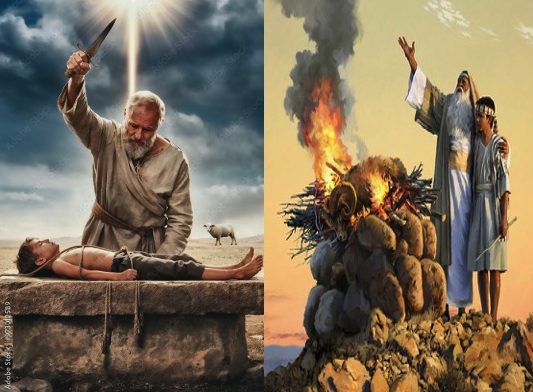
God later tested Abraham’s trust and devotion by asking Abraham to offer his only son Isaac as a sacrifice.
Genesis 22:2: Then God said, “Take your son, your only son, whom you love—Isaac—and go to the region of Moriah. Sacrifice him there as a burnt offering on a mountain I will show you”.
After Abraham passed the test, God provided a ram in a nearby bush for the sacrifice (rather than Isaac).
Genesis 22:12-14: God said to Abraham to not lay a hand on the boy. God said. “Do not do anything to him. Now I know that you fear God, because you have not withheld from me your son, your only son. Abraham looked up and there in a thicket he saw a ram caught by its horns. He went over and took the ram and sacrificed it as a burnt offering instead of his son. So, Abraham called that place The LORD Will Provide. And to this day it is said, On the mountain of the LORD it will be provided.
adobe.com/search?k=abraham+and+isaac&asset_id=973012589 / https://www.pinterest.com/pin/2181499815863842/
Isaac
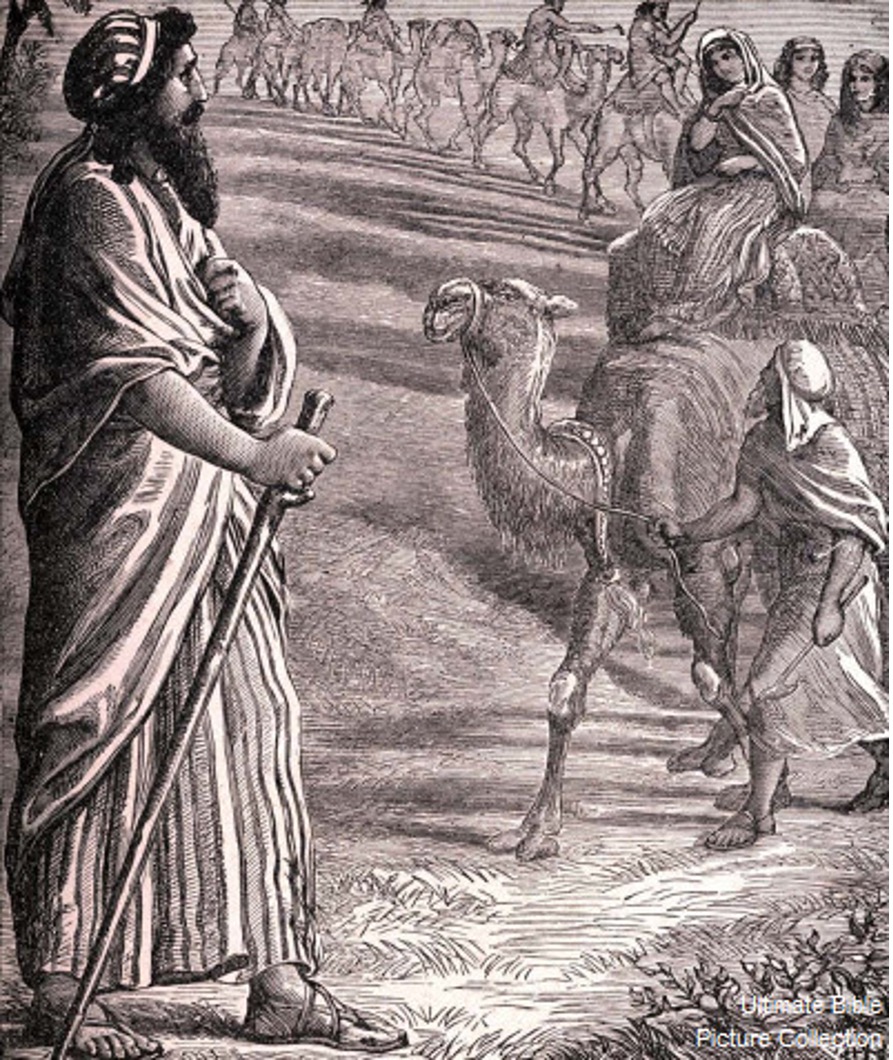
Abraham’s son Isaac was deeply grieved when his mother Rebecca died. Genesis 24 recounts the story of Abraham sending his servant to find a wife for Isaac. The servant prayed to God for His divine guidance.
When he reached Rebekah’s family, he immediately told them about Abraham and Isaac. Then Rebekah agreed to go with him. Genesis 24:67 explains how...The servant told Isaac all he had done. Therefore, Isaac brought her into the tent of his mother Sarah, and he married Rebekah. She became his wife and he loved her greatly and Isaac was comforted after his mother’s death.
https://bibleencyclopedia.com/pictures/Genesis_24_Isaac_meets_Rebekah.htm
Jacob
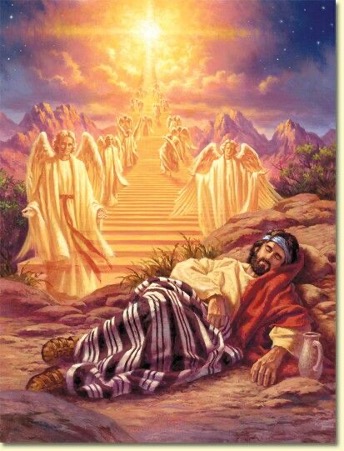
When Isaac’s son, Jacob, had to leave because he stole his brother’s blessing, he had a dream on the way. Genesis 28:13-15 describes the dream.
Genesis 28:13-15: There above it stood the Lord and He said: “I am the Lord, the God of your father Abraham and the God of Isaac. I will give you and your descendants the land on which you are lying. Your descendants will be like the dust of the earth, and you will spread out to the west and to the east, to the north and to the south. All peoples on earth will be blessed through you and your offspring. I am with you and will watch over you wherever you go, and I will bring you back to this land. I will not leave you until I have done what I have promised you.
https://www.pinterest.com/pin/344595808963014947/
These are just a few examples of God’s intervention in the patriarchs’ lives. In each of these instances, the men knew God was speaking to them. However, they did not know the name of God. God called Himself the God of Abraham, Isaac, and Jacob until Moses’ time. He was identified as God who acted on behalf of these men, leading to the establishment of the people of Israel. When Moses asks God’s name, he was aware of the rich history of God’s intervention in his ancestor’s lives.
As He did with Abraham, Isaac, and Jacob, God was calling Moses to follow His direction into the unexpected. When Moses saw the burning bush that did not burn up, God referred to himself as the God of Abraham, Isaac, and Jacob.
Exodus 3:6: I am the God of your father, the God of Abraham, the God of Isaac and the God of Jacob. At this, Moses hid his face, because he was afraid to look at God.
God then tells Moses He will be used to bring the Israelites out of Egypt. Moses asks how he can do this because of who he was. Next Moses asks for God’s name in case the Israelites ask who sent him. That is where God gives his name as “I AM WHO I AM”.
Exodus 3:14: God said to Moses, “I am who I am. This is what you are to say to the Israelites: ‘I am has sent me to you”.
Baker’s Dictionary associates YHWH (the name of God that Jewish people will not pronounce) with this passage in Exodus 3:14 and provides some helpful understanding.
God, Names of - Bible Meaning & Definition - Baker's Dictionary | Bible Study Tools,
The meaning of the name yhwh may best be summarized as "present to act (usually, but not only) in salvation". The revelation of the name is given to Moses, "I am who I am" (Exodus 3:14).
The name yhwh specifies an immediacy, a presence. Central to the word is the verb form of "to be”, which points in the Mosaic context to a "being present", and may in Israel's later history, as some suggest, have come to mean "I (and no other god) Am" (Isaiah 41:4, Isaiah 4:10).
For Moses and for Israel the question was not whether the Deity existed, but how that Deity was to be understood.
The theological significance that attaches to the name yhwh is multiple. Judging from the etymology… the name signifies "presence". God is "with"...He is near and among His people. Yahweh is present, accessible, near to those who call on Him for deliverance, forgiveness, and guidance. Yahweh is dynamically near, but as God (Elohim – yihi \) He is also paradoxically transcendent.
In his commentary, Matthew Poole further describes the verb tense used in Exodus 3:14. (Matthew Poole's Commentary)
That tense in the use of the Hebrew tongue comprehends all times, past, present, and to come, to signify that all times are alike to God, and all are present to Him.
Considering the all-encompassing nature of God’s character, any attempt to describe Him falls short. By declaring himself as “I AM WHO I AM” emphasizes that He is the basis of all. He has always been and will always be. At the same time, He is present to act on behalf of man. Given that God is the basis of all, it is critical that we align ourselves properly with Him. Once we do align with Him, we can be sure that He acts on our behalf.
In his exposition of the entire Bible, Gill expounds on the name God gave to Moses. (Gill's Exposition of the Entire Bible)
And God said unto Moses, “I am that I am”....This signifies the real being of God, His self-existence, and that He is the Being of beings...as also it denotes His eternity and immutability, and His constancy and faithfulness in fulfilling His promises.
The richness of God’s presence and action as expressed in the name He gave is the basis of our relationship with Him. When Jesus was on earth, He was called a blasphemer when He identified himself as being God. The gospel of John records seven “I am” metaphors Jesus used to refer to Himself. In each metaphor He addressed a human need and said that He was the answer. There are 2 additional times that Jesus said “I am” when He referred to Himself. It was one of these two “I am” references that infuriated the Jewish leaders since they saw that He equated Himself with God.
I am the bread of life - John 6:35, 41, 48, 51
...He is your bread of life.
Jesus had just met the physical need of hunger in those listening to Him. Once their physical need was satisfied, Jesus took the opportunity to point out the deeper hunger in our spirits for relationship with God. When He said He was the bread of life, He was saying that He was able to meet that need. When we are in right relationship with Him, there is no lack in our spirits.
I am the light of the world - John 8:12 & 9:5
...He is your light in this world.
Before Jesus claimed to be the light of the world, a man born blind had asked to be healed. Jesus used his blindness to highlight the fact that we all live in spiritual darkness. In saying He was the light of the world, Jesus said He provides the light and understanding we need to live. He brings clarity where confusion exists. He brings hidden things into the open.
I am the door - John 10:7-9
...He is your door.
The door Jesus alluded to is the door of the sheepfold. During Jesus’s day in Israel, the shepherd would be at the door of the sheepfold after the sheep were gathered in for the night. As a result, nothing could enter or exit the sheepfold without going by or through the shepherd. In the same way, nothing can come our way unless it is allowed by Jesus. More importantly, Jesus claims that He is the way to God.
I am the good shepherd - John 10:11, 14
...He is your Shepherd.
Sheep were a critical part of life in Israel during Jesus’ time. They were a source of clothing (wool), food, and sacrifices to God. At the same time, sheep are vulnerable to predators, unable to provide for themselves, and sometimes go astray. The shepherd’s job was to care for and protect the sheep. Psalm 23 gives a beautiful description of the Lord’s provision for us as our shepherd. Notice that He not only provides water, but He provides still water. He not only gives rest, He provides rest in a green pasture, a place of comfort.
Psalm 23 - The Lord, the Psalmist’s Shepherd.
~ A Psalm of David ~
The Lord is my shepherd,
I shall not want.
He makes me lie down in green pastures.
He leads me beside quiet waters.
He restores my soul.
He guides me in the paths of righteousness for His name’s sake.
Even though I walk through the valley of the shadow of death, I fear no evil, for You are with me.
Your rod and Your staff, they comfort me.
You prepare a table before me in the presence of my enemies.
You have anointed my head with oil.
My cup overflows.
Surely goodness and lovingkindness will follow me all the days of my life and I will dwell in the house of the Lord forever.
I am the resurrection and the life - John 11:25
...He is your resurrected life.
Jesus was called by Mary and Martha to come heal their brother, Lazarus. In that culture, the sisters would have had a hard time without their brother to provide for them. Before Jesus raised Lazarus from the dead, He claimed to be the resurrection and the life. In raising Lazarus from the dead, He met the need of that family and also showed His power in a tangible way. In the same way, He is our resurrection and life. In Him, we will one day be raised to eternal life. In the meantime, He is all we need to live this life.
I am the way and the truth and the life - John 14:6
...He is your way, your truth, and your life.
When Jesus said He is the way and the truth, and the life, He was saying He was the only way. There is no other way to become right with God.
I am the true vine - John 15:1-5
...He is your vine and you are His branches.
I am the true vine, and My Father is the vinedresser. Every branch in Me that does not bear fruit, He takes away and every branch that bears fruit, He prunes it so that it may bear more fruit. You are already clean, because of the Word, which I have spoken to you. Abide in Me and I in you. As the branch cannot bear fruit of itself unless it abides in the vine, so neither can you, unless you abide in Me. I am the vine, you are the branches. He who abides in Me and I in him, he bears much fruit, for apart from Me you can do nothing.
When Jesus says that He is the true vine, He means that He is our source. In John 15, Jesus says that as we remain in Him, we will bear fruit. It is in our fruit-bearing that we are seen as His disciples. He provides the nourishment we need to be fruitful in our lives and for that fruit to be good fruit.
In John 8:58-59 Jesus directly associated Himself with the God of Abraham, Isaac, and Jacob (and Moses) when He said before Abraham was “I AM”. The Jewish leaders of His day understood that Jesus was claiming to be God. They considered this to be blasphemy, that required His death. Ironically, His death was the very requirement for atonement for our sin.
John 8:58-59: Your father Abraham rejoiced at the thought of seeing My day. He saw it and was glad. You are not yet fifty years old, they said to Him, and you have seen Abraham! Very truly I tell you, Jesus answered, before Abraham was born, “I am”! At this, they picked up stones to stone Him, but Jesus hid Himself, slipping away from the temple grounds.
John 18:4-6: Jesus therefore, knowing all things that should come upon Him, went forth, and said to them, Whom do you seek? They answered Him, Jesus of Nazareth. Jesus said to them, I am He. And Judas also, who betrayed him, stood with them. As soon then as He had said to them, I am He, they went backward and fell to the ground.
John 8:58-59: Your father Abraham rejoiced at the thought of seeing My day. He saw it and was glad. You are not yet fifty years old, they said to Him, and you have seen Abraham! Very truly I tell you, Jesus answered, before Abraham was born, “I am”! At this, they picked up stones to stone Him, but Jesus hid Himself, slipping away from the temple grounds.
John 18:4-6: Jesus therefore, knowing all things that should come upon Him, went forth, and said to them, Whom do you seek? They answered Him, Jesus of Nazareth. Jesus said to them, I am He. And Judas also, who betrayed him, stood with them. As soon then as He had said to them, I am He, they went backward and fell to the ground.
Much research has been done to identify the deepest needs each human being has in life, and the things identified are common to us all.
Our needs (some of these can obviously overlap):
...To be unconditionally loved and accepted.
...To belong where you feel important and valuable.
...To be engaged and feel significant.
...To be understood for your authentic self and to understand yourself at the deepest level possible.
...To have autonomy or the freedom of self-determination.
...To have genuine intimacy.
...To experience self-actualization (the process of achieving one’s full potential and purpose in life.)
...For self-transcendence. (the realization that you are part of a greater whole and acting accordingly, because your life has meaning and that you matter to others.)
Summation
To feel connected with purpose and significance.
Now think about our deepest needs in relationship to Jesus being “Our I Am”. When you become a Christian, you become 100% merged with the eternal life of Jesus Christ. You become one with the “eternal I am”.
1 Corinthians 6:17: But the one who joins himself to the Lord is one spirit with Him.
Galatians 3:28: There is neither Jew nor Greek, there is neither slave nor free, there is no male and female, for you are all one in Christ Jesus.
Colossians 2:9-10: For in Christ, all the fullness of Deity dwells in bodily form and in Christ, you have been made complete...
- “I AM” your intimacy!
...God loves you and you love God and you exist in His love. There is no greater intimacy than to be one with the creator of the world, who loves you and died for you on the cross.
- “I AM your security!
...God accepts His only beloved Son and His Son accepts you and therefore His Father accepts you. There is no greater unconditional acceptance than Christ’s acceptance. He accepted you to such an extreme degree, that He made you part of His eternal life. You are in Christ and Christ is in you.
- “I AM” your purpose in this life and in eternity.
...Jesus is fully engaged in God’s will and His work and you are engaged in Him...John 14:12: Very truly I tell you, whoever believes in me will do the works I have been doing, and they will do even greater things than these, because I am going to the Father.
- “I AM” your engagement in the work of God’s kingdom on earth.
...Philippians 2:13: For it is God who works in you, both to will and to work for his good pleasure. My Father is working until now, and I Myself am working, and you are working with them and they are working in and through you.
- “I AM” your self-awareness!
...You are aware of yourself in and through me. God the Father knows who He is. Jesus the Son knows who He Is. The Holy Spirit knows who He is. They know who you are and you become fully aware of who you are in them.
...Galatians 2:20: I have been crucified with Christ and I no longer live, but Christ lives in me. The life I now live in the body, I live by faith in the Son of God, who loved me and gave Himself for me.
- “I AM” your eternal presence!
...He is always present and you are always present with Him.
...Psalm 139:7-10:Where can I go from Your Spirit? Or where can I flee from Your presence?
If I ascend into heaven, You are there!
If I make my bed in hell, behold, You are there!
If I take the wings of the morning,
And dwell in the uttermost parts of the sea,
Even there Your hand shall lead me,
And Your right hand shall hold me!
- “I AM” your eternal permanence!
...He always exists and you always exist in Him and with Him.
...Ecclesiastes 3:14: I know that everything God does will remain forever. There is nothing to add to it and there is nothing to take from it, for God has so worked that men should fear Him.
...Hebrews 7:24-25: But because Jesus lives forever, He has a permanent priesthood. Therefore He is able to save completely those who draw near to God through Him, since He always lives to intercede for them.
- “I AM” your immutability and constancy.
...He never changes and you will never change in Him.
...Hebrews 13:8: I am the same yesterday and today and forever.
Jesus as the eternal “I Am” includes all time...past, present, and future (to come). The sense is not only “I Am” at present, but I am what I have been, and am what I shall be, and shall be what I am. You...as a born-again Christian are right in the center of the “I Am”.
----------------------------------------------------------------
If you have never ask Jesus, the “Great I Am”, to come into your life, save you, and give you the His free gift of eternal life, would you like to now? If you will, He will respond to you immediately and become “Your I am” in all the ways explained above and infinitely more. Please just say this simply prayer directly to the Lord Jesus:
Lord Jesus...I believe you are the eternal Son of God, who left heaven and came down to earth as a human being, so you could live out the perfect life, that I have failed to live. I have sinned in every way the Bible says I have and I want to be forgiven right now, for both the sins I have committed and for my inner-sinfulness, that caused me to do the sins. Cleanse me through your precious holy blood and take over my life as my Lord and Savior...my “I Am”.
In your name I pray...Amen!
Blessings,
Rhonda Gobble
PS: Here are a few testimonies of those who have experienced the reality of their oneness with Jesus...the I Am...on an ongoing basis. I hope these encourage you.
Mildred Lisette Norman, the Peace Pilgrim
Born Mildred Lisette Norman, Peace Pilgrim is a notable American figure who felt a constant divine presence throughout her life. Her journey began during a period of spiritual unrest in her thirties. She felt compelled to call out to God, asking to be used for a higher purpose.
Her experience:
- A feeling of peace overtook her and never left.
- She vowed to give away her belongings and serve others for a cause greater than herself.
- In 1953, she began a cross-country trek on foot to promote peace and unity.
- Wearing a simple tunic, she walked over 25,000 miles over two decades, sharing a message of inner and outer peace.
- Her spiritual state was a constant communion with God, which she described as a "constant receiving from within".
Harriet Tubman, "Moses" of the Underground Railroad
Harriet Tubman, a key figure in the Underground Railroad, also described a constant spiritual guidance that she attributed to God. As a devout Methodist who escaped slavery, she returned to the South multiple times to help others escape.
Her experience:
- She relied on what she called "the voice of the Lord" to guide her on her dangerous missions.
- Despite being illiterate, she memorized scripture, sang gospel songs, and prayed regularly.
- Tubman credited her faith and God's guidance for the strength and courage she needed to free others.
- She attributed her success on the Underground Railroad entirely to God, never to her own strength.
Gabrielle Bossis (1874-1950)
“Be in love with mysteries. They are there to prove your childlike trust in the Father.”
A trained nurse, playwright and actress, A Gabrielle Bossis began to receive messages from God as a young child. This continued throughout her life. For decades, Gabrielle pursued God privately while touring as the lead actress in her plays. Then, in her sixties, she felt God’s call to write a book about his messages to her, so that others would know that intimacy with Christ is not just for those in cloisters but accessible to all. Published anonymously in 1948, Lui et moi (He and I) encouraged a deep relationship with God. As her health declined after a sudden illness in 1950, Gabrielle did not fear death but, rather, looked forward to it. This inner peace came after she asked God what was next, and he replied, “It will be I. Forevermore.”—Vanessa Leahey, Editorial Intern
Florence Nightingale (1820-1910)
 “To be a fellow worker with God is the highest inspiration of which we can conceive man capable.”
On February 7, 1837, Florence Nightingale, considered the mother of modern nursing, wrote in her diary, “God spoke to me and called me to his service.” In a scandalous choice for an upper-class nineteenth-century British woman, she answered that call by becoming a nurse. Her renowned career included training nurses in the Crimean War and pioneering medical practices now viewed as standard. A prolific reader and writer on the topics of public health, sanitation and statistics, Florence also researched and wrote about spirituality and mysticism. She believed in the coexistence of science and religion as well as the need to organize one’s existence around God’s will. In heeding God’s call, Florence led a life of scientific and spiritual service, leaving a legacy of inspiration and wisdom. —Amanda Ericson, Editorial Intern
Brother Lawrence
He maintained a constant fellowship with God through a spiritual practice known as "the practice of the presence of God".
Brother Lawrence, a lay brother in the Carmelite monastery in Paris in the mid 1600s, introduced the spiritual discipline of Practicing the Presence of God. He worked in the kitchen and sandal repair shop, and learned to be in God’s presence while doing chores.
Brother Lawrence developed the gift of praying incessantly with God throughout the his day regardless of whatever he was doing. This produced such a change in him that many people sought him out for spiritual guidance.
After he died, his letters and conversations were compiled into the book, The Practice of the Presence of God. It simply and beautifully explains how to continually walk with God, not from the head but from the heart.
The following quotes are taken from An Abridged and Contemporary Version of The Practice of the Presence of God: The Best Rule of a Holy Life, Letters by Brother Lawrence, edited by Don Milam.1
Brother Lawrence describes what it means to practice the presence of God.
Turn your thoughts towards God as often as you can. By small steps, get used to this small but holy exercise. Think of God as often as you can.
Make it your habit to maintain an intimate, humble, affectionate conversation with Him.
I may call this the actual presence of God or more appropriately, it is a habitual, silent, and secret conversation of the soul with God.
Think often on God, by day, by night, in your business, and even in your entertainments. He is always near you and with you. Leave Him not alone. You would think it rude to leave a friend alone, one that came to visit you. Why then must God be neglected? Do not then forget Him, but think on Him often, adore Him, continually live and die with Him.

Do you have some thoughts, feelings, or questions about what you read today in this specific devotional/commentary?
If you will submit those using the form below, Gene can read them, study them, and reply to them just as soon as possible.