
Psalm 68:5: A father of the fatherless and a judge for widows, Is God in His holy habitation.

https://www.instagram.com/p/C7tmszuM5Hy/
My earthly father died in a tractor accident when I was 10 years old. Suddenly, I was thrust in the world of a child in a single parent home. I struggled with the reports of children in single parent homes being at a disadvantage in life. In 2022, the US Census bureau reported that one in four US households are headed by a single parent. Black children live in single parent homes at twice this rate in the United States. Worldmetrics.org reports many statistics that emphasize the disadvantages of children from single parent families.
Single Parenting Statistics
Single-parent families face higher risks across learning, health, finances, and emotional well-being, with major impacts by age 24.
At age 24, children from single parent homes face a 50% lower likelihood of college enrollment, and nearly 3 in 4 families also report overlapping pressures like housing instability and delayed healthcare. From 20% exposed to community violence to 30% living in neighborhoods with limited access to quality education, these statistics map how everyday stress can shape outcomes across childhood. The full dataset connects the dots, down to unmet educational needs and the ripple effects of limited time, money, and support.
Key takeaways
- Children in single-parent homes are 3 times more likely to have behavioral problems (e.g., aggression, defiance)
- 25% of children in single-parent families read below grade level by 3rd grade
- Children from single-parent homes have a 50% lower likelihood of college enrollment by age 24
- 80% of single-parent households are headed by mothers, with 17% single fathers and 3% grandparent caregivers
- 45% of single parents report struggling to afford housing, compared to 19% of two-parent families
- Single parents spend 15 hours more per week on unpaid care work than married parents
- The median income of single-parent families is $42,000, compared to $78,000 for two-parent families
- Single mothers have a poverty rate of 20.4%, while single fathers have a rate of 11.3%
- Single parents hold only 2% of the nation's total household wealth
- Single parents have a 30% higher risk of depression than married parents
- 45% of single parents report high levels of stress on a daily basis
- Single parents are 2.5 times more likely to experience burnout than married parents
- 60% of single parents report receiving some form of government assistance (e.g., SNAP, TANF)
- Only 35% of eligible single parents receive Temporary Assistance for Needy Families (TANF)
- 40% of single parents access community childcare subsidies
I was determined to live above those statistics, so set out to prove the statistics wrong, or at least that they did not apply to my family and me. I worked hard to excel in school. My mother was a teacher and was able to provide for our family through her profession. However, I was still insecure and feared what would happen if my mother also died.
A few years after my father died, someone shared Psalm 68:5 with my mother. She took the verse to heart and understood that God was her advocate since her husband was gone. She relied on the Lord to help her make decisions that would have otherwise been very difficult. Some of that help came in the form of good friends and family. Other help came as she prayed for God to intervene on our behalf.
When I heard that God is a father of the fatherless, I took that promise literally. I was saved, but now I saw Him as my Father. That meant four things: First, since He is God and has all power, He was adequate for every need. Second, since He is all wise and knows me best, He could guide me in the right and best path for my life. Third, since He is all knowing, He would be aware of all I do, good and bad. Finally, He is the perfect Father and has perfect love. I felt like I now had the best Father in the world, though not one I could physically touch. Knowing Him as my Father means that it is not my responsibility to beat the statistics. I must simply rely on His guidance as the perfect Father He is and follow where He leads me.
As I look back over the years, I see that God has indeed been a wonderful Father to me. He has been patient as I have sometimes strayed. He has guided me in the “Big” decisions in life. And, I have known His love, comfort, and guidance along the way.

https://www.istockphoto.com/photo/little-girl-praying-in-front-of-american-flag-gm154961959-16365326?searchscope=image%2Cfilm
In I Kings 17:9-16 there is a great illustration of God being a judge to a widow and a father to the fatherless. During this time in Israel, widows were destitute. Their husbands were the providers and the woman was often seen as cursed or judged if her husband died. They would often be very poor. While she was in this state, the Lord told Elijah to go to a certain widow’s house and she would provide food for him. She had only a small amount of flour and oil left that she planned to cook as a last meal for herself and her son.
Elijah asked that she cook it for him instead and promised that she would have enough to eat until rains came again to the earth. She agreed to do this. Verse 16 says,
The bowl of flour was not exhausted nor did the jar of oil become empty, according to the word of the Lord which He spoke through Elijah.
In the next section of this chapter, the boy died. This left the woman even more destitute since she would not have a son to care for her in her old age. Elijah prayed that the boy would come back to life. verse 22 says,
The Lord heard the voice of Elijah, and the life of the child returned to him and he revived.
God did two miracles through Elijah for the widow and for her fatherless son. Similarly, God continues to work on the behalf of widows and the fatherless today. Psalm 68:5 specifically mentions the widow and the fatherless; however, other verses throughout the Bible show that God advocates for the humble, the downtrodden, the weak, the outcast, and the despised.
Jesus regularly ministered to the despised and downtrodden. John 4: 7-26 describes Jesus’ interaction with a Samarian woman. She was at a well when Jesus asked her for a drink. She said to Jesus,
How is it that You, being a Jew, ask me for a drink since I am a Samaritan woman? (For Jews have no dealings with Samaritans.)
Later Jesus asks her to go get her husband, but she has none. She is then living with a man, but is not married. In this culture, the Samaritans were considered second class. This woman led an immoral life and would have been despised as a result. Jesus reached out to meet her in that state. Her reaction was to go tell the men of the city about Jesus, who knew everything about her.
The account of Jesus calling Levi (Matthew) as a disciple is in Mark 2:14-17.
As He passed by, He saw Levi the son of Alphaeus sitting in the tax booth, and He said to him, “Follow Me!” And he got up and followed him.
Later Jesus went to Matthew’s house and was eating with many tax collectors and sinners”. In those days, tax collectors had the job of collecting taxes on Rome’s behalf. They would charge more than the tax that was due and kept the excess. As a result, they were shunned by the Jewish establishment and considered thieves. Jesus chose Matthew from this lifestyle and Matthew then introduced Jesus to his friends who were also tax collectors.
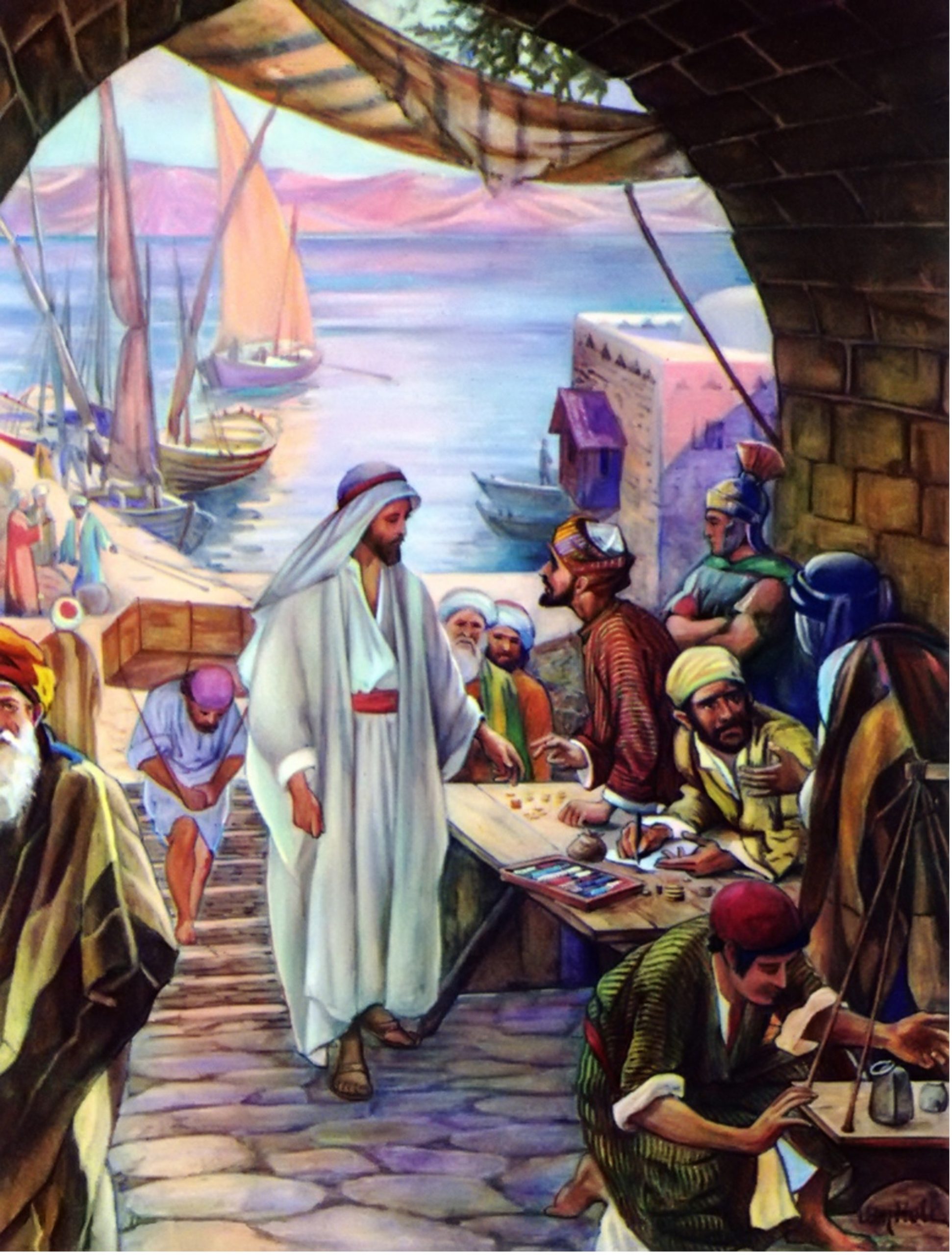
https://www.google.com/url?sa=t&source=web&rct=j&url=https%3A%2F%2Ffreechristimages.com%2Fbible-stories%2Fcalling-of-st-matthew.html&ved=0CBYQjRxqFwoTCJjpwKDWxpUDFQAAAAAdAAAAABAL&opi=89978449
There are many other examples of God using the weak, the despised, and the outcasts to do His work. In fact, God often chooses these very people for His work. He only asks that we follow Him as He directs us. In fact, God’s love is not limited to the fatherless. Each of us has a circumstance in our lives that may make us feel unworthy. God is big enough (more than big enough) to meet us where we are and to use us as we follow Him.
While the knowledge that God cares for the downtrodden and less fortunate, often choosing them for His purpose, our response must be to redeem the lessons we have learned through trials and hardships. It is not enough to rest in His care. We must use those lessons to help others around us.
Prayer: Thank you, Lord, that You care for the widow, fatherless, and orphan. Thank you that You care for all who are downtrodden, despised, and rejected. You reject no one who comes to You in faith, accepting You as Savior and Lord. Help me comprehend the greatness of Your love for me and desire to use me to further Your kingdom through the life lessons You have taught me.
Blessings,
Rhonda
PS: My fear that my mother would die happened when I was 37 years old. She died as a result of a car accident. While losing her was heart-wrenching, knowing God as my Father and that He will never die, has helped immensely. I was now an adult orphan. The Bible talks about orphans in a similar way as the fatherless (See Exodus 22:22, Isaiah 1:17, Psalm 146:9, John 14:18).

Do you have some thoughts, feelings, or questions about what you read today in this specific devotional/commentary?
If you will submit those using the form below, Gene can read them, study them, and reply to them just as soon as possible.
Hmm? As I aged and still alive at 77+ years I am surprised that I have been granted such longevity. Somehow, I have yet to understand why me being alive and not many others that are more worthy who had “A Lot” more to offer just by living longer. This reading really makes me feel awkward because it goes against what I consider “Perfect” decisions? My own memory remembers many regrets I could have avoided had I lived a much shorter lifespan. The “Military Draft” in 1967 which took me into a way of life that I wish I could have avoided had I just had other options (college – only family living member – not qualified – etcetera); could have been a starting point. Even now! At 77+ years I cannot understand God’s “Perfect” decisions on how life is being led. Was that worded correctly? More insecure that life has meaning? Maybe a third (3rd.) reading might give better clarity?
Great thoughts Ruben. I think many of us feel the way you do and wonder why are we still here, when so many others who we think could have done great things and gone on to be with the Lord. May God bless your humility.I think all you and I can do is trust in what God said in the Proverbs, “A man makes his plans, but the Lord directs his steps. God’s overriding sovereign power is always at work.
MY wife may try to respond to you also when she can. She still works full time and less time than I do, but will be so grateful that you felt led to comment on her devotion.
Take care!
Gene
Hello,
I think we all have questions about what we have done in the past and what has happened in our lives. I sure do. I try to remember that God is sovereign and is great at taking my failures, shortcomings, and hurts and redeeming them. I have to believe that God knew what He was doing when my earthly father died. And, I am sure that much of who I am is a result of that. The main reason I wrote this devotion is that it has been a lifelong journey to walk with God as my Father and understand that He is completely loving, in all that comes my way. My prayer is that others can read about what I have learned over many years and be able to grasp God’s love and care more quickly than I have.
Rhonda